
shop_mcp_server
An MCP server in Rails that gives Claude real access to a store's products, orders and inventory, with semantic search on pgvector.
Project · Production-style AI support agent in Ruby on Rails (in progress)
A Rails support agent that investigates customer problems, checks real order data and takes safe actions only with human approval. Built lesson by lesson.
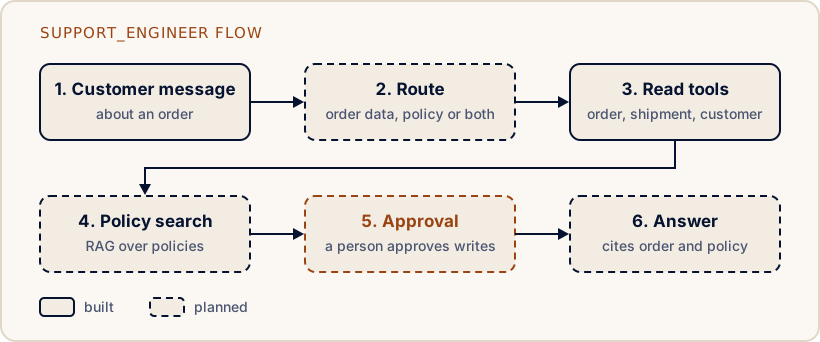
In progress. Lessons 1 to 3 of 14 are done: real and planted data, the first LLM call, and four read tools the model chooses between. A hand-written agent loop, an MCP server, policy search, approvals and evals come next. This page marks what works today and what is planned.
Most AI support demos are chatbots that sound confident and guess. A real case needs more than a fluent answer:
“My order #1042 has not arrived and it has been two weeks. If it is lost, please send a replacement.”
To answer correctly, a system has to look up the order, check the shipment, find the lost-package rule in the shipping policy, decide whether a replacement is allowed, and get a person to approve it before anything changes. Then it has to cite where each fact came from.
get_order and get_shipment.| Tool | Type | Rule |
|---|---|---|
get_order, get_shipment, get_customer, search_orders, search_policies |
Read | Automatic |
update_address |
Write, low risk | Automatic after a policy check |
create_return, create_replacement_order |
Write, high risk | Human approval |
issue_refund, cancel_order |
Write, high risk | Human approval and confirmation |
Lesson 1, data. The data layer. The importer loads the public Olist e-commerce dataset (about 99,000 orders and 96,000 customers) into six tables, and a seed task plants five fixed scenarios with known answers: a delayed shipment, a lost package, a closed return window, a final-sale item and a duplicate charge. Each scenario will become an eval case.
Lesson 2, the first LLM call. A SupportAgent built on RubyLLM answers through Groq (openai/gpt-oss-120b), with its system prompt in its own template file.
Lesson 3, read tools. get_order, get_shipment, get_customer and search_orders are plain Ruby services with thin RubyLLM tool wrappers, and the agent may only call those four.
get_order, get_shipment and search_orders for matching questions.Three milestones in 14 lessons: a working agent (LLM calls, tool calling, the agent loop, MCP, RAG), quality and safety (routing, hybrid search, approvals, evals, observability), and advanced topics (memory, multi-agent orchestration, deployment). Progress is tracked in the repo.
Need something like this in your own product? See AI engineering and integration and Full-stack Ruby on Rails development.
An MCP server in Rails that gives Claude real access to a store's products, orders and inventory, with semantic search on pgvector.
A shopping chat where the AI searches Shopify's live catalog over MCP instead of making products up.
An AI agent that scores how discoverable a Shopify product is to AI shopping assistants (GEO and AEO).